With the rapid growth of digital infrastructure and the increasing volume of equipment housed in data centers, basic questions such as "U" and "units" in server cabinets – what are they? At first glance, this is a simple technical value, but it determines how much space the equipment will occupy, how it will be installed, and how efficiently the rack will be used. Understanding what a unit means and what role it plays in the infrastructure is essential for both engineers and business representatives making server placement decisions.
However, in practice, many clarifying questions arise: "what is one unit equal to?", "how does its size relate to centimeters?", "how do you estimate the occupied space and plan equipment placement in a cabinet?" Without a clear understanding of these aspects, it's easy to run into space shortages, scaling difficulties, and excessive costs. In this article, we'll step by step examine what a unit is, how it's used in server cabinets, and how this knowledge is applied when selecting and leasing space in a data center.
Contents:
What does a Rack Unit (U) mean in a server cabinet?
A Rack Unit (U) is a basic unit of measurement for equipment height used in server cabinets and data center racks. In other words, a U is a conventional increment used to determine how much rack space a specific device occupies and how much equipment can be placed within the cabinet. This approach allows for the standardization of server, network, and other components, regardless of manufacturer.
The term itself originates from the standardization of telecommunications and server equipment, which required standardizing device dimensions for compatible installation. As a result, a general principle was adopted: all equipment intended for rack installation is designed in multiples of Rack Units (U). This eliminates incompatibility and simplifies both infrastructure design and subsequent operation.
The role of a unit in a data center goes beyond a simple arbitrary unit. It serves as a universal language for communication between engineers, equipment suppliers, and data center operators. This enables precise cabinet occupancy planning, standardization of deployment processes, and predictability when scaling the infrastructure.
What is 1 rack unit (dimensions and standards)?
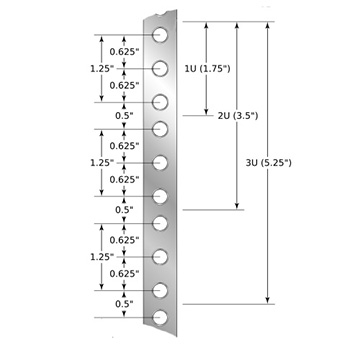
U has a strictly fixed value, established by industry standards for server and telecommunications racks. One rack unit (1U) in a cabinet is 44.45 mm (1.75 inches), or 4.445 cm high. In practice, this value for the server itself is often rounded to 1.719 inches (43.7 mm) or 44 mm (4.4 cm). However, when designing and placing equipment, it is the exact value that is used as a guide, since even small deviations accumulate when filling the entire rack.
It is important to keep in mind that 1U is This isn't just the "clear" height of the device, but also the space provided by the standard, taking into account mounting requirements. Server cabinets use rails with mounting holes arranged in a standard pattern, where each unit includes not only the usable height but also clearances for installing equipment and securing it with screws. These clearances are already included in the standard itself and therefore don't require separate consideration in calculations.
Therefore, when discussing the value of one unit, we're not talking about an abstract value, but rather a strictly standardized height of the mounting space in the rack, ensuring compatibility between equipment from different manufacturers and proper installation in the server cabinet without additional adjustments.
Where can I rent a Unit in Moscow?
Server colocation using Units (U) is a practical and cost-effective colocation format. However, it's not just price that matters, but also the reliability of the site, the engineering infrastructure, and the level of service. Moscow offers a wide range of data centers, but when choosing one, it's important to consider a range of factors: power supply stability, cooling quality, physical security, ease of access, and technical support.
Safeharbor Data Center offers Units (U) rentals in server cabinets as an optimal solution for server colocation without the need to rent an entire rack. This format is especially convenient for small and medium-sized projects that require one or more servers with the ability to scale. Clients gain access to a professional infrastructure, including guaranteed power supply, redundancy of key systems, climate control, and 24/7 monitoring.
Special attention is paid to ease of use: organized cable management, a clear layout structure, and prompt technical support allow you to focus on business tasks rather than infrastructure maintenance. If necessary, data center specialists assist with equipment installation, replacement, or diagnostics.
Therefore, renting units at Safeharbor is more than just placing equipment in a server cabinet; it's a comprehensive service that combines flexibility, reliability, and transparent terms. This solution is suitable for both starting out and gradually expanding your IT infrastructure without incurring excessive costs.
Data Center Unit Rental: How It Works and Why Choose It
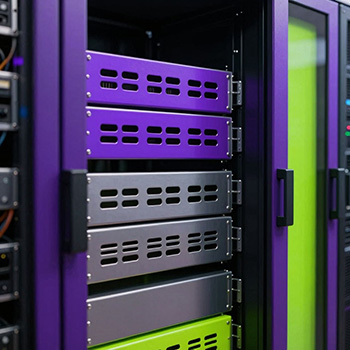
Data center unit rental is a server colocation model where the client occupies only the required number of units within a server rack, rather than the entire server rack. Essentially, it's a strictly defined rack space with access to the entire data center infrastructure: power supply, cooling, communications, and security systems. This approach allows for flexible resource management and pays only for the capacity actually used.
Unlike leasing an entire rack, where the client receives the entire cabinet regardless of its occupancy, unit leasing is focused on targeted deployment. This significantly lowers the entry barrier: there is no need to immediately invest in excess capacity or reserve space "for the future." At the same time, scalability is maintained—as the infrastructure grows, the number of units occupied can be gradually increased without changing the site or complex migration.
The U-based leasing format is especially popular with companies that need to accommodate a limited amount of equipment: from a single server to several units of network or computing equipment. This includes small and medium businesses, startups, developers, as well as projects testing new services or launching pilot solutions. Key advantages include: Cost-effectiveness, predictable costs, a quick start, and no need to deal with engineering infrastructure issues.
Therefore, renting units in a data center is a rational balance between a professional hosting environment and flexible resource use, allowing you to build your IT infrastructure in stages, without unnecessary costs and with the possibility of further growth.
Examples of equipment of different heights (1U, 2U, 4U, etc.)
The height of a device in units is directly related to its purpose, performance, and design features. The more units it occupies, the more space it typically has for components, cooling, and expansion. In practice, server cabinets use a wide range of form factors—from compact 1U solutions to larger systems.
The most common options are:
- 1U—compact servers and network devices. Most often, these are web servers, routers, switches, and other solutions where packaging density is important. Limited internal space is compensated for by high component integration.
- 2U—a more versatile format. Used for servers with increased drive counts, RAM, or additional expansion cards. The balance between compactness and performance makes it one of the most popular.
- 3U-4U — hardware with an emphasis on performance and expandability. These enclosures accommodate powerful servers, storage systems (SAN/NAS), and solutions with a large number of drives or GPUs.
- 5U and above — specialized devices. These can be high-performance computing nodes, large storage systems, or custom hardware requiring increased space for cooling and components.
The choice of height for internet equipment depends on the tasks: if maximum density is the priority, compact solutions are used, while if performance, scalability, and fault tolerance are important, higher form factors are preferred.
FAQ
How are units measured in server cabinets?
In practice, units aren't measured with a ruler—they're measured using the rack's own markings. The rails are provided with groups of mounting holes, grouped into repeating blocks corresponding to one unit, as well as numerical markings that allow for quick orientation when installing server equipment. Typically, every three holes... This is 1U.
Why are rack units important when arranging equipment in a data center?
Standardization simplifies work: you can easily move server equipment to any region, and it will fit in the right size, whether in Asia, Europe, or Russia. Rack units allow you to precisely distribute space within the cabinet and avoid chaotic installation. This simplifies maintenance, speeds up the installation of new devices, and minimizes errors in layout planning.
How do I choose the right number of rack units for placement?
The calculation is usually made with a small margin. This takes into account not only the current equipment but also possible expansion, as well as ease of access for maintenance. Too dense an installation can complicate operation and upgrades.
Can I install non-standard-sized equipment?
Yes, but with limitations. If the device does not fit into a rack-mount form factor, it may require special shelves, adapters, or custom placement solutions. This should be considered in advance, as these options are less convenient and may take up more usable space.
Are UPSs and cables included in the rack-mount unit count?
Yes, any equipment installed in a server rack, including rack-mount UPSs, occupies a certain number of rack units. Cables themselves are not counted in rack units, but their routing and organization require space, which indirectly affects the rack density.
Is it possible to rent half a rack unit?
In some cases, such offers are available, but in practice, they are the exception and not the most convenient format. Server equipment is designed in multiples of full rack units, so "fractional" placement complicates installation, limits the choice of devices, and can create difficulties during maintenance. That's why renting a whole number of units remains the standard and most rational practice.